Inside The Tactical Evolution Of USA’s U20 World Cup Team
- Gary Curneen
- Oct 21, 2025
- 9 min read


Following the recent success of the United States team at the U20 World Cup, we were excited to have Alessandro Davite take such a deep dive into the tactical evolution of the USA U20 team. Alessandro has worked on the analysis side at first team level with Inter Milan and Roma, and also as Head of Technical/Tactical Analysis with Malta Football Association. His background as a UEFA A licensed coach and tactical analyst, combined with his experience working in elite youth environments across Europe, makes him uniquely equipped to dissect a team like Marko Mitrovic's — one defined by flexibility, positional intelligence, and modern build-up play.
Below is Alessandro's assessment of the United States U20 World Cup campaign.
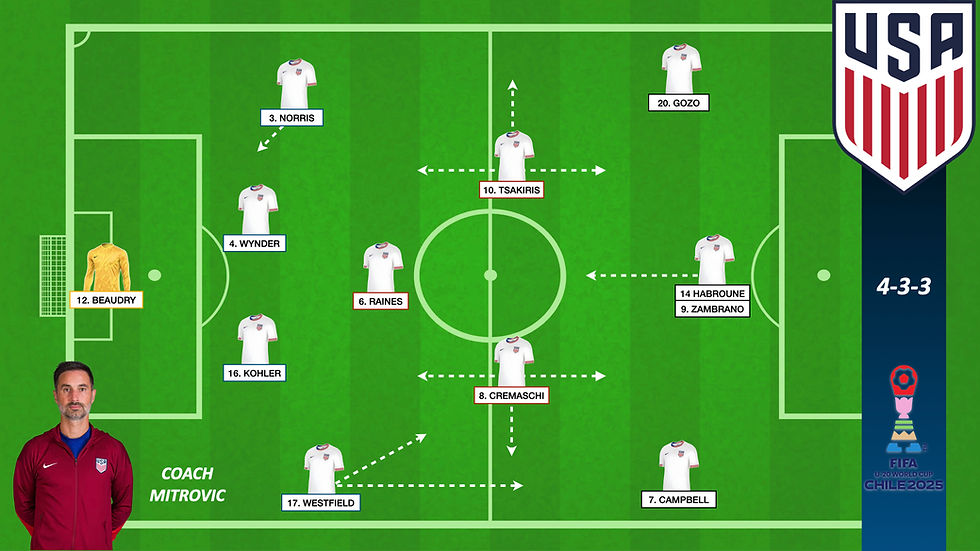
Labeling the U20 USA squad coached by Marko Mitrović as a simple 4-3-3 would not do justice to a team that displayed both an elevated football IQ and impressive tactical flexibility. Their offensive dynamics were distinctly modern, filled with nuanced details that maximized each player’s characteristics and tendencies.
To provide a quick overview of the key individuals featured during the World Cup:
1️⃣ Beaudry (GK) – composed with the ball and capable of finding free teammates under pressure.
2️⃣ Defensive unit: Wynder and Kohler (CBs) proved reliable both in and out of possession; right fullback Westfield played a vital role in exploiting width, either advancing high or moving inside the pitch, while Norris on the left consistently provided a build-up option.
3️⃣ Midfield trio: Raines, operating as the holding midfielder, was essential for balance; Cremaschi and Tsakiris, the two interiors, offered quality and creativity, serving as true link players.
4️⃣ Front line: Gozo and Campbell, the primary wingers, brought speed, depth, and 1v1 ability to uncover spaces, while the strikers offered contrasting profiles — Habroune, reminiscent of Dembélé in his movement patterns, and Zambrano, a more traditional number nine.
SHAPE & DYNAMICS VS NEW CALEDONIA/SOUTH AFRICA
Team USA were setting up mainly with a diamond 3+1 when facing a defensive 4-4-2 structure (as shown against New Caledonia and South Africa). (PIC 1-2)The aim is to overcome the pressure by exploiting 3 players (usually defenders, but not only) to generate a numerical superiority against the opposite 2 forwards. The diamond sees usually Raines (or another CM) as top of the vertex, always positioned behind the strikers’ line and well positioned to receive.

Normally, the LB Norris is the one connecting with the CB’s and CM, while Westfield on the other side is free to move upwards or coming at times inside the pitch. The inside midfielders Cremaschi and Tsakiris vary their position based on the pressure applied by the opposition: advancing with no pressure on the ball during build up or dropping when needed.

SHAPE AND DYNAMICS VS MOROCCO
Some strategical changes were made against Morocco in the quarter-final.
Raines and Corcoran (another midfielder) were highly involved during the build up phase countering the 4-4-2 of the African side. Their task was to recreate a dynamic shape involving 5 men, mostly displaying a diamond (3+1) plus an open midfielder (here Raines). The designed movement (from inside to outside) made by the number 6 would eventually drag out the Moroccan LW with the possibility to have Westfield in an advanced position (5vs4 on the defensive line).

On a few occasions, it was interesting to see also the diamond shape with both Raines and Tsakiris providing solutions on the flanks acting almost as wingbacks. So, whenever a winger would start pressing two options could be opening up: one inside to the CM and one outside. Another advantage to this shape is given by the ability to stretch horizontally the opposition while keeping the ball and then finding a progressive lane either centrally or laterally.

Having four 'true' midfielders in the starting line-up (Raines, Corcoran, Cremaschi and Tsakiris) was properly tailored to gain advantages in terms of creating and discovering spaces, plus retaining possession. Here it’s evident how the team could dynamically move and generate an overload.


SHAPE AND DYNAMICS VS FRANCE/ITALY
In these two giant clashes Habroune was definitely a key element tactically speaking. Despite different defensive systems and pressing behaviors, France deploying a man on Raines and controlling the fullbacks with a 4231 while Italy working with a 3-2 pressing structure, team USA could exploit his striker as an extra-man when building up.
It’s rather easy to identify the general principle: making use of a +1 man against their first line of press. So, in this case, the 4vs3 would solve the problem. However, Habroune with his elusive movements would act as another playmaker or linking player allowing another teammate to advance or adjust: sometimes being a decoy, surprising the opposition or generate an overload.These two moments (pics below) look identical even if they took place in separate games: Habroune drops centrally without being pressed, shutting down the rival’s defensive trap.


Not only in central areas, this was also occasionally seen in wide areas utilizing the fullback as well. (See below)

DEVELOPING THE OFFENSIVE ACTION
COMING OUT FROM HIGH PRESSURE (GK INVOLVEMENT)
It rarely happened that the opposition was able to press high and efficiently the team USA during this World Cup. However, the few times the situation occurred, the “Stars and Striped” squad was confident and happy to involve the goalkeeper attracting the rivals near to its own box and then coming out with effective plays progressing upfront.
This situation, against France, shows at first the CBs and the GK Beaudry easily beating the striker press finding Wynder. Therefore, the LCB is able to drive forward. (See below)

Since, the midfielders are all paired due to the French strategy, Habroune becomes the extra player enabling the team to progress on the pitch (the RCB has tracked him down until the midfield circle and then stopped).

Tsakiris, smartly unmarking himself, receives forward to the goal with four teammates attacking the defensive line. A promising chance has been created. (See below)

In this particular action against Italy, Kohler is forced back to the GK, due to an effective man-to-man pressing strategy applied by the “Azzurri”. (See below)

Once Beaudry had received the ball, one main solution appears productive: searching for Raines and possibly progress finding Wynder as third man. The American 'number 6' with a great move (sense of position and body orientation mixed with composure) dodges the RCM pressure and advances centrally. (See below)

Habroune, Cremaschi and Tsakiri all understood the situation and were coming to the rescue. All behind the main pressing block of Italian players they become now active parts of an “artificial” offensive transition, where Habroune takes the scene as the linking player. (See below)

Finally, the shadow striker decides to launch Campbell behind the defensive line probably committing a mistake in terms of best potential choice.


LINKING UP & PROGRESSING (UNDER PRESSURE)
Dealing with intense pressure is monumental in modern elite game the USA were prepared strategically to win this battle against the opposition defensive system. For example, against Italy the American squad was planning to bring Cremaschi on the right side in order to drag out the LCM from a central position while simultaneously blocking the LWB with Westfield advanced.

Therefore, space is created centrally thanks to Habroune and Tsakiris positioned over the Italian pressing block of players. Finally, Raines finds diagonally the number 10, progressing the play. (See below)

In this other situation against New Caledonia, who were able to press intensely with 4 men and forcing USA out, Cremaschi understands to get closer in order to provide a passing option. (See below)

In fact, the number 8 (once receiving) is able to see the whole pitch in front of him. Basically, he play the linker role allowing the 4+1 building up structure to have 4 attacking players attacking the defensive line. (See below)

SETTING UP WITH TIME ON THE BALL & ATTACKING EXPLOITING WIDTH AND DEPTH (NO PRESSURE APPLIED)
Team USA set themselves up with different shapes in possession. They consistently look for a numerical superiority on the opposite defensive line (5vs4) using changeable players. Functions over roles. The offensive structure is mainly represented by the 325 and 415 set ups with their hybrid variations. For example, in the match with France, they were even able to bring the two fullbacks on the attacking line, while the MIDs and CBs were involved as builders.(See below)

A more common formation is shown here below against South Africa. The defenders and the holding midfielder, Raines, are connected in order to build up, while the attacking midfielders and the attacking trio work on the defensive line.

Exploiting width and depth is always key to create chances, especially when no pressure is applied by the opposition. That’s when being well positioned provides a clear advantage. The “Stars and Stripes” squad had the ability to both stretch and move horizontally the opposite defensive unit as much as vertically by attacking depth. In practical terms, whenever there is an open opportunity, the team utilize 'switch of plays' to the wide players on the flanks or discovering the space behind the defensive line. The most common shape would see the attacking midfielders pushing high at the same height (or slightly lower) of the attacking players (ST, RW and LW). Meanwhile, the holding mid provides balance in front of the defensive unit. (See below)


OFFENSIVE THIRD SOLUTIONS
OVERLOAD
An occurring solution throughout games was related to overload, which mainly happens on lateral channels. In the situation here described against New Caledonia, is easy to spot how Westfield (RB) – Campbell (RW) – Cremaschi (RAM/inside mid) are connected aiming to exploit a numerical and positional advantage while Kohler (RCB) is driving the ball towards their zone. (See below) The overloads are sometimes happening naturally thanks to their behavioral dynamic approach or either are planned ahead.

FINISHING ZONE & CROSSING
In every game played by Team USA there always had been the consistent pursuit of specific assist and finishing zones. Most of the times trying to conquer the lateral space located aside to the penalty box in order to put the ball in from a profitable position. In details, the cross or cut-back is arriving especially after a fast attack (“artificial transition” or open ball) where the wide players are able to receive meanwhile having numbers in front of the goal.
In the first game against New Caledonia, as usually occurred in the other matches, the inside mid (here Tsakiris) is attacking this “lateral golden space” passing through the FB-CB channel which can be considered as the cut-back assist zone. Looking at the image (See below) , the wide player who receives (here Gozo) needs to drop in order attract the fullback out and to create a good angle to play a trough ball behind the line for a 2° line attack.

Once exploited the space, having taken the advantage, there have been steadily at least 3 players inside the penalty box: one attacking the first post (mostly the striker), one attacking the 2° post (the opposite wide player coming in, either fullback or winger) and one attacking the penalty spot zone for the cut-back (usually a midfielder). Below, Cremaschi scores the 2-0 goal.

In the round of 16, having to deal against 5 defenders, the ideal plan was to drag out the side CB in order to then exploit the lateral golden space. Otherwise the 5 attacking channels would be occupied not gaining a numerical advantage. (See below)

Here was Westfield to discover the lateral space with an insertion run from a long distance. (See below)

Once the ball is delivered there are always at least 3 players dividing the attacking zone among them. In addition, here the wide player (Gozo as a RW) is able to enter the penalty box as well after playing the ball into the space. (See below)

Even in the quarter final against Morocco, a promising chance was created early into the match from the same zone after Campbell received a long ball and won his duel against the defender. (See below)

The main difference in having 3 or 4 players inside the box is highly related to the nature of the action: 1) if the team is discovering or accessing that lateral golden space with one of the 5 attacking players thanks to a direct attack or a 1vs1 situation, it’s likely to have 4 players ready to finish; while 2) if one of the 5 attacking players is used to drag out a defender, then it’s probable to have 3 in the box.
FINAL ASSESSMENT
Team USA demonstrated throughout the whole tournament to be a dominant and modern side, only stopped by a team like Morocco with shown a great ability to stay alive and making the shaping the conditions of the game to suit physicality and gamesmanship. Offensively, the US squad was always prepared strategically and ready to adapt to the changing scenarios of the game. As a fundamental principle, they always relied on a +1 man build up against the rival’s pressure. Then having at least one man positioned behind the line of pressure (particularly Raines).When the ball is pressed the attacking midfielders and even the striker (especially Habroune) would drop to help the team progressing.Within an open ball situation, the main set up would see the squad split into five 'builders' and five 'invaders/finishers'. The structures would then variate to 3+2/5 attackers or 4+1/5 attackers mainly depending on the plan and opponent.Surely the Mitrovic’s squad can’t be limited to the starting 4-3-3 formation, in fact the offensive dynamics are showing a great adaptability and flexibility which makes Team USA really difficult to deal with.Another weapon is generating lateral or central overloads which is quite common for them. Those can be achieved through positional-qualitative advantages or relational combinations.